
The many types of leather are defined by the which layer of the hide is used and how that layer is finished.
The many types of leather are defined by the which layer of the hide is used and how that layer is finished.
Most upholstery and garment leathers are chromium tanned, which lends to a softer, stretchier hide. After tanning, a hide is mechanically split into grain leather and suede.
- Full grain leather keeps the natural surface intact, including scars. Because the outer fiber structure is undisturbed, full grain leather is the strongest and most durable of all real leather types. Only a small number of hides qualify as full grain.
- Top grain leather is lightly sanded or buffed to reduce blemishes and create a more uniform appearance. It is not quite as strong as full grain but still high-quality and durable. Most furniture and garments are made with top grain.
- Suede is the lower, weaker portion split from the grain.
The finishing process determines how the leather behaves, and this is where the types of leather are confused. Terms like ‘aniline’ and ‘semi-aniline’ describe not only the dye used to pigment the hide but also how much protective finish is applied to the surface. That finish determines whether the leather absorbs liquids or wipes clean and thus its resistance to stains, sun-fading and its repairability.
Most upholstery and garment leathers are chromium tanned, which lends to a softer, stretchier hide. After tanning, a hide is mechanically split into grain leather and suede.
- Full grain leather keeps the natural surface intact, including scars. Because the outer fiber structure is undisturbed, full grain leather is the strongest and most durable of all real leather types. Only a small number of hides qualify as full grain.
- Top grain leather is lightly sanded or buffed to reduce blemishes and create a more uniform appearance. It is not quite as strong as full grain but still high-quality and durable. Most furniture and garments are made with top grain.
- Suede is the lower, weaker portion split from the grain.
The finishing process determines how the leather behaves, and this is where the types of leather are confused. Terms like ‘aniline’ and ‘semi-aniline’ describe not only the dye used to pigment the hide but also how much protective finish is applied to the surface. That finish determines whether the leather absorbs liquids or wipes clean and its resistance to stains, sun-fading as well as its repairability.
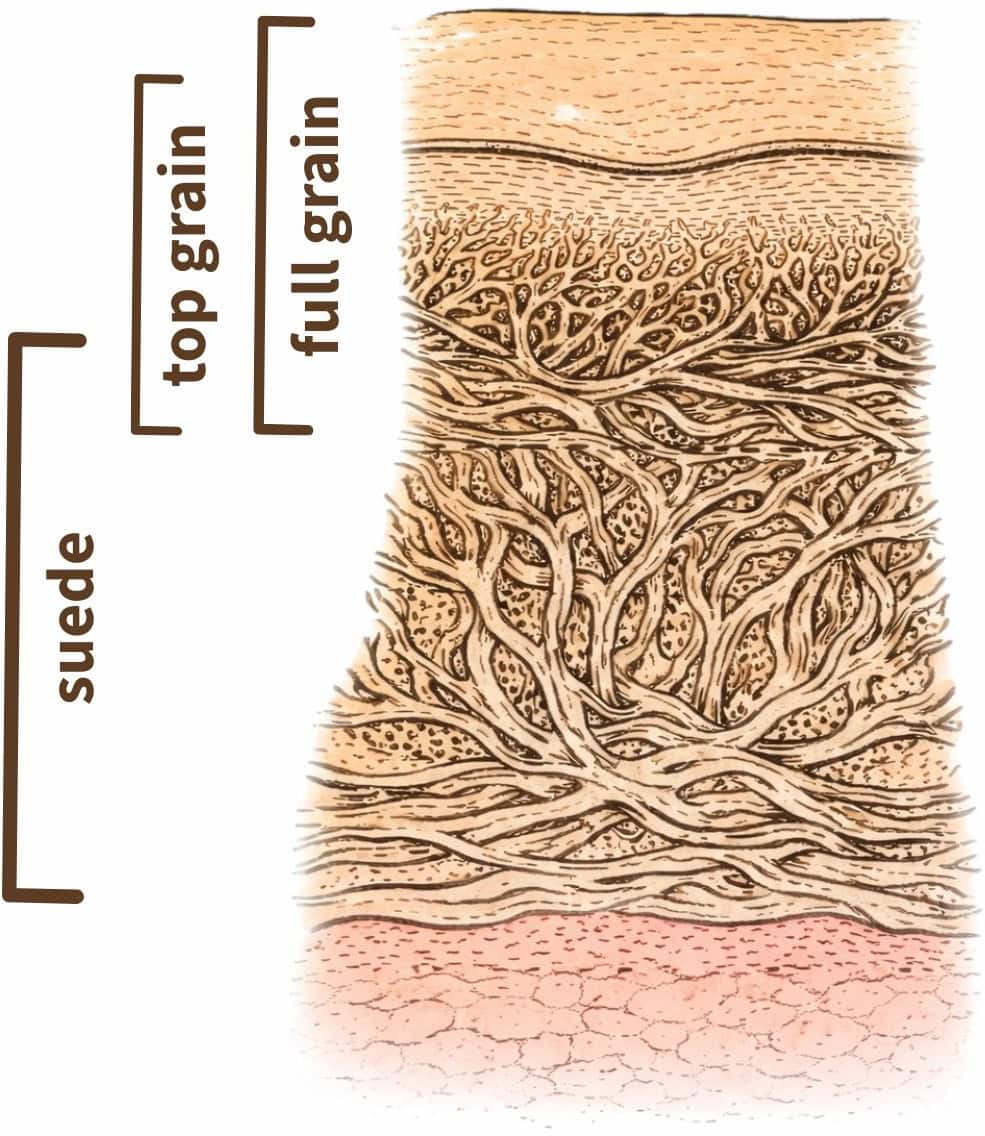
Suede is the lower, weaker portion split from the grain.
Top grain leather is full grain, but with the surface sanded down to remove blemishes.
Full grain leather is the whole top surface, or "grain", of the leather
Nubuck is top grain leather that has been finely sanded and brushed to create a velvety nap. It is beautiful but high maintenance. Although technically a grain leather, it behaves more like suede, and:
- absorbs liquids immediately;
- stains easily;
- sun-fades.
Applying a protective finish flattens the nap and permanently changes its character. Once sealed, it is no longer nubuck. Thus, correction options are limited.
Nubuck
Aniline
Aniline leather can be full grain or top grain. Dyes enhance the natural variation and marbling, but it has little to no protective coating. Because of this, it:
- is highly absorbent;
- stains easily;
- sun-fades;
- develops patina over time.
Its absorbency means it can be conditioned or re-dyed. It can also be repaired or finished, though the latter will cool its buttery, warm feel and care must be taken to maintain or mimic the leather's natural marbling.
Semi-aniline leather has a thin protective coating, so unworn areas feel slightly smoother and cooler than aniline. It also:
- absorbs more slowly,
- resists stains better,
- ages more evenly,
- but can still fade, scuff, and crack.
Its absorbency lends well to conditioning and dyeing. It can also be repaired and refinished, though care is needed to maintain or mimic the leather's natural marbling.
Semi-Aniline
Pull-Up
Pull-up is full grain or top grain leather infused with oils and waxes and designed to distress rather than remain uniform. When bent or scratched, the oils shift, and the color lightens temporarily until rubbed out.
Pull-up leather:
- resists liquids better than aniline and semi-aniline,
- and develops a rich patina.
It is still absorbent, so it can be conditioned and dyed. However, any repairs or finishes will conceal the pull-up effect.
Finished leather is full grain or top grain coated with one or more layers of pigment and sealed with a clear topcoat. This is the most common type of leather used in furniture and car interiors.
Finished leather:
- repels liquids and resists stains,
- resists scuffs,
- minimizes fading.
Because the surface is sealed, conditioners and dyes cannot effectively penetrate without aggressive stripping and deglazing. However, finished leather is easily repaired.
Finished Leather
Suede
Suede has been split and separated from the grain and is the lower, weaker half of the hide. It has a shaggy, almost furry texture, which makes it:
- highly absorbent and
- prone to stains.
Because it lacks a grain surface, suede cannot be repaired or refinished like other leathers. It can only be dyed with suede dye.
Bicast leather, also called finished split, is made by coating the weak split suede with polyurethane and embossing a grain texture. Buyer beware! It's often marketed as 'genuine leather'.
Initially it repels liquids, but over time the coating may:
- become sticky,
- crack and tear
- or delaminate.
Once the coating fails, the suede beneath is exposed. It's not a candidate for conditioning and dyeing. Repairs are difficult and not as durable as those performed on grain leather.
Bicast (Finished Split)
Bonded Leather
Bonded leather is made by grinding leather scraps into fibers, mixing them with adhesives, forming sheets, and coating them with polyurethane. While it contains leather, it is the equivalent of cheap particle board. DuraBlend® is a common brand trademarked by Ashley Furniture. Bonded leather:
- initially repels liquids,
- but delaminates, peels, and flakes.
Repairs are painstaking and short-lived, as demonstrated here.
Faux leather is nearly identical to bonded leather except that it uses a polyester backing. It is 100% synthetic and contains no animal hide. Ultraleather® is a popular brand. Like bonded leather, it:
- repels liquids initially;
- eventually cracks, peels, and delaminates.
Faux leather is rarely worth repairing, as demonstrated here.
Vegan/Faux Leather
Faux Leather Fabrics
Some faux leathers (like LeatherAire® brand) have a polyurethane coating that wears more naturally. Still, you can expect them to:
- initially repel water, but
- become absorbent with wear,
- and expose a lighter, fuzzy microfiber.
All that can be done is to stain or paint the fabric and then coat it in clear wax it to create a leather-like appearance.
Vinyl (PVC) is a heavier-duty synthetic material used in marine, commercial, automotive seating. It is often paired with finished leather in home furniture and called 'leather match'. Naugahyde® was a trademarked name in the 1950s. Vinyl:
- repels liquids,
- resists scuffs and fading,
- but does eventually crack.
Because it repels liquids, conditioners just sit on the surface. Vinyl cannot be effectively dyed, but it is usually worth repairing, and can be refinished (painted).
Vinyl (PVC)
The simplest way to identify different types of leather is to test absorption.
- If unworn areas absorb water immediately or gradually, the leather is has a thinner protective finish.
- If water beads up and does not absorb on unworn areas, it is finished leather or a synthetic.
If you need help, consult the pro.
Hello – I’m so excited to use your product! I have a TOP GRAIN leather love seat, and your website description of Top Grain Leather includes this: “top grain repels liquids and resists stains”. I’m wondering if that’s a comment about durability in that it repels liquid & resists stains from typical use, such as spilled drinks, OR, does that mean it will repel and resist me attempting to use your products to stain it a new color? Thank you for your help!
The urethane finishes used on many top grain leathers tend to repel water, liquids and other stains, which means they need to be cleaned a bit more aggressively, with our water-based cleaner followed by a solvent (rubbing alcohol at the least, denatured alcohol is good, even paint or lacquer or thinner). This repellency also means that a noticeable change of color may prove to be more maintenance than simply restoring with a matching color.
I have a 2014 528i BMW, bought it used and there is some type product on the leather door panel handle grips that is sticky/tacky and it rolls off like putty. This makes dirt and grime stains and comes off onto my hands, especially in the hot summer days. Do you have any suggestions?
I haven’t laid eyes on a 2014 model, so I’m not sure if BMW phased out the horrible decal-like coatings on the interior door handles that chipped and flaked away (VW used them too). It might just be heavy detailers’ dressing (that we derisively dub slime), in which case try stripping it off with rubbing alcohol. You may have to step up to lacquer thinner to get it off, and hopefully it doesn’t leave a white hazy mess. Even so, that could be corrected with a new finish. The only caution is to make sure you don’t start stripping off paint or decal such that you’ve got a chipped, uneven look. If you bought it used, it may have been repaired or refinished, not merely doused in slime. We can be of more help if you upload a photo.
I have a reconstituted (I think bonded) leather couches. The problem is that they are a really light beige, and they have been looking really dirty almost from the beginning. They are really comfortable, but obviously they look dirty and I have tried everything to clean them. I would like to know if it’s possible to dye them a darker color? Thank you
Many synthetics (unless stained by rather unusual circumstances or mold), often clean up with either 409 or alcohol or both and a toothbrush. If they don’t, it’s often because the material is wearing through. With faux leathers, there are sometimes they are embossed with thousands of little pores (we’ve dubbed ‘holey ultraleather’) or the polyurethane finish wears down to fabric. In general we discourage changing color or applying much of anything to bonded, composite or faux leathers. The fabric ones are somewhat salvageable when stained / painted and coated in a clear wax. You can email a clear, close-up photo of the material’s texture to info@rubnrestore.com.
I inherited a recliner chair, so it is approximately 50 years old. Across the top of the chair the leather is VERY crusty and stiff, probably due to body oils and sun. The leather is not absorbent. Is there a product to make the leather soft and pliable? I have cleaned it with alcohol and water.
Also this area could use some additional batting to help with the sagging, but there is no zipper or spot to add more. The back of the chair is one piece of leather from top to bottom. Thoughts??
Thank you.
Sounds like a gentle sanding with 320 grit could help even the crustiness. Just take care not to tear up the fiber. After that I’d try some of ADV’s Leather Protector found here. Later you can fill the cracks in the leather and refinish if deemed necessary.
My father left me 2 jackets….sort of bomber style leather jackets that was very expensive (over $500). One is old and brown color worn to where it is as if there is no color at all in many areas – almost ivory.
What is the best way to restore color? It seems there was a seal or finish which isn’t shiny but not a dull mat finish either?
On the second jacket, there is no color loss yet but what is the best product to use to keep the leather soft and moist – keep from drying out? Some have said mink oil but….
Thank you so much for any help.
The faded jacket should restore beautifully with a similar brown, especially if the leather is absorbent. Beware of kidskin leather, which is very thin, soft, and stretchy. That might do better with a true dye, rather than a finish. For the unfaded jacket, we suggest ADV Leather’s Conditioner & Protector.
I have a pair 2007 car seats. The seating surfaces are leather but there is a material on the sides and back which is synthetic, but feels very similar to the leather in texture and look. It is light gray and I want to refinish it in blue. Is your “ rubnrestore” right for this application? I intend to spray the restore on.
We are not inclined to recommend color changing auto interiors with our system due to the propensity for touch-up. You’ll have less maintenance with a heavier duty acrylic-urethane blend. Try Refinish Coatings.
The seller called it “Italian leather.” When I got it home I realized that it had scales coming up on the front of the seats. Is there anything I can do to keep it from getting worse?
The leather is probably dried out and chafed or damaged by body oil. Add more batting to the cushions (if they can be unzipped) to plump them up and reduce stress on the leather. Then repair the scaliness with filler.
how big of an area does this cover. thinking of doing my hot tub cover
In general, an 8 oz. bottle covers 60 square feet, but vinyl spa covers often drink up more. This article and video have more information about restoring hot tub covers.
I have a 3-seat cognac leather sofa and ottoman that I want to dye camel with your product. As well as dyeing it I’d like to make the feel warmer first. I was thinking of sanding. Will that work or can you advise a better approach?
Refinishing leather is not going to make it warmer in temperature. Sanding will remove any roughness or wear and make it feel smoother.
My new spa cover is a much lighter brown than anticipated. Can the vinyl material be darkened with your product?
Yes. Please read about changing colors here. You can order swatches.
I bought an upholstered faux leather bed frame in white but the color is actually off white. I want to recolor the faux leather to a bright white so it matches my other furniture. Would I be able to use Bright White Vinyl & Leather Finish on my furniture?
If it’s vinyl (PVC), yes. If it’s polyurethane (PU), we don’t. Learn more about PU faux leather and color changing.
I have a recliner but am not sure what kind or leather it is but I am certain it is not absorbent, does your product work on both absorbent and none absorbent leathers? Thank you!
Yes, please read about absorbency here.
Does your product work on non-absorbable leather that the top layer of color has been rubbed off of?
Thank you in advance!
Yes, so long as the surface is intact, our finishes will correct discoloration. See more about spot touch-up here.
I have a stadium sofa piece that I got from Room to Go iij t is black and resides in my man cave/garage in the hot and humid New Orleans area. It is some type of cheap or bonded leather that is starting to wear off. Not horrible but starting. Do you have a product for this?
I could send picture if u have that ability.
You can email a picture to info@rubnrestore.com but please read/watch this first.