
Welting (or piping) is the corded trim sewn along the edges of cushions. It reinforces seams, but if and when the leather or vinyl becomes damaged, it presents a challenging repair due to the curves and adjacent seams.
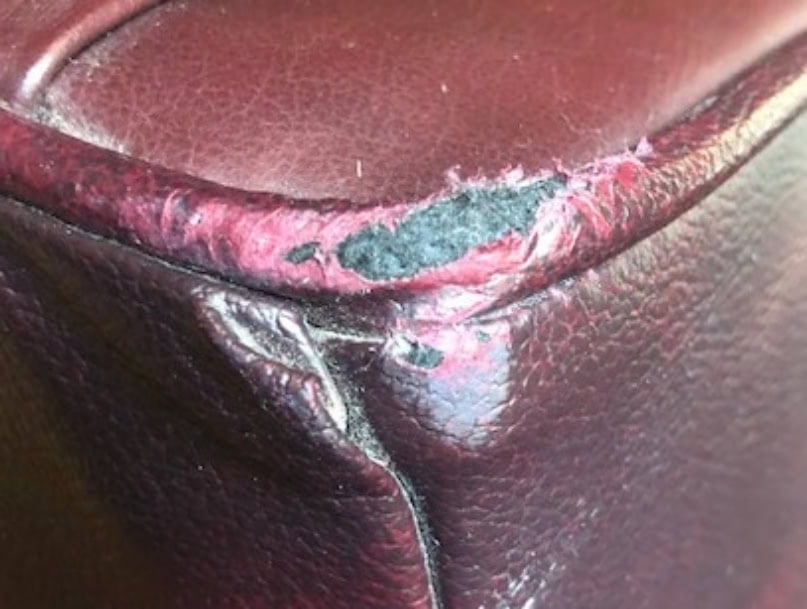
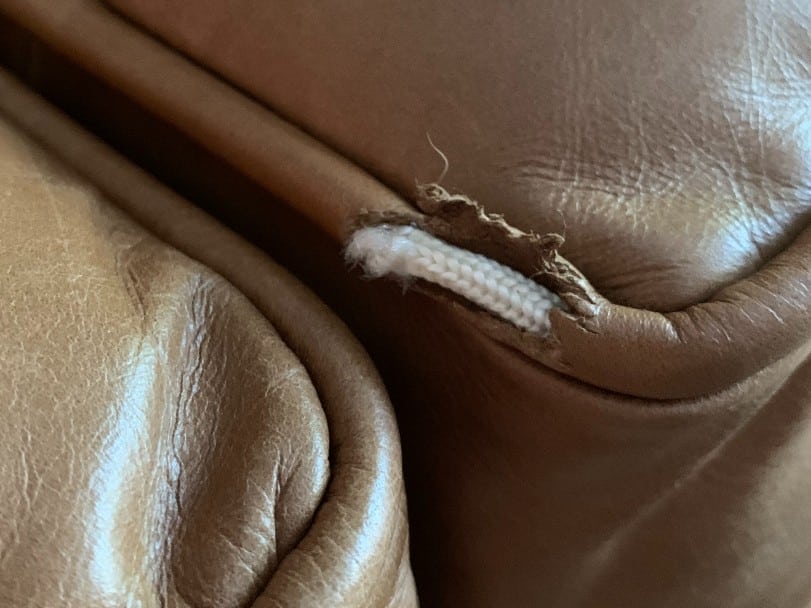
If the damage exposes a cord over which the leather or vinyl floats freely, a subpatch is needed to close the hole, maintain separation between these elements, and restore structural integrity. The denim or twill in our subpatch kit is too thick. Organza or a thin polyester mending tape are better.
In either case, the key is to avoid getting any putty in the seams, which, if allowed to cure, will obscure the shadow line and result in a solid, patched look.
This difficult process is demonstrated on this vintage Coach bag:
Subpatching
- Cut the patch slightly larger than the hole, and round all corners.
- If the binding curves around the corner of a cushion or bag, arm of a chair, etc. you may have to cut out little triangular notches. To determine where and how many, center the patch over the hole and mark where where it wrinkles and creates bulk.
- Carefully insert the patch into the hole (adhesive side up if using mending tape). Ensure there is no overlap or wrinkling. This is a challenge, and you most certainly will have multiple attempts, may widen the hole, and may need to cut another patch.
- When seated, use a needle tool to apply tiny beads of flexible fabric glue to the inside of the surrounding piping, contact firmly, and let cure.
Filling & Refinishing
- Trim or remove any flappy, chafed bits. Apply a small blob of filler to the area. Spread it around as evenly as you can using a palette knife or needle tool, taking care to work it under any edges.
- If you have an artist's spatula great. Otherwise use a piece of index card or flexible business card to gently scrape and level the putty. You can also used your gloved fingers to trace the piping. You may find its best to do both directions (parallel with the piping and perpendicular) to evenly fill the gouges.
- Before it begins to cure, use a clean tool to remove all traces of putty from the seams. Gently feather the perimeter of the putty with a finger tip or use alcohol and a q-tip to thin and erase any harsh lines.
- Allow to cure (direct sun speeds this along).
- Use rubbing alcohol to erase or smooth any imperfections in the cured filler.
- Let return to room temperature.
- Repeat steps 2-5 until the gouged area feels even.
- Apply a thin final coat and quickly texturize with a finger tip, if necessary, and allow to cure.
- Apply color and clear finish, if needed.
Hello, I wonder if u can advise me. I just bought a used RV and the furniture looked brand new. That was only 2 months ago. Now the piping is seriously peeling but the cover’s themselves still look great despite 3 large dogs jumping up and down on them. Do you have any advice on repairing the piping since the rest still looks perfect? Thank you!🙏🏻
We’ve seen real leather upholstery with faux piping, but much of RV industry uses faux leather throughout. You’d have to call the manufacturer with the VIN to confirm this. If it’s faux leather, train the dogs not to use it. Best you can do for the piping is the same process described above. Just take care to peel away as much as you can of the existing material and try to not overlap the filler on what remains. Take a look at this article and video before investing too much time or money into peeling faux leather.
The other issue is matching color. You do not want to change the color of faux leather. Will one of our standard colors be a perfect match? Probably not, and the matching fee is cost prohibitive for a small bit of piping. It would be worth it, however, if the rest of the upholstery is indeed genuine leather.
Thanks so much. I’m wondering too if the coverings are real leather because the dogs have put a scratch across the top of the couch but never has tried to peel and actually looks like a leather scratch. Very curious to me. Do you have a video of you repairing piping? I saw the article but it’s more about repairing a hole in the piping. Anything on repairing just peeling piping? Thank you! And for color match, would not matter if I can get the peeling off because piping is a lighter contrast color to the coverings.
Is there a kit available to do these repairs please?
Subpatches, glue, filler, and tools sold individually or in kits are available here. Note that you’ll need a matching color to conceal the repair.
What is piping or welting please? What does it look like and of course I will send photos when I can access the item again which is presently out of town. Thanks for your kind reply.
Hi folks….I have a vintage saxophone case made of leather which dates back at least 50 years to it’s manufacture in France. There are some missing, chafed leather spots where the leather has worn thin. More importantly is the vinyl trimming that has been stitched around the cases perimeter. It is now gone, with my having removed it, rather that allow it to remain in tatters.
I am seeking suggestions as to how I can repair or replace the missing leather spots but particularly interested in knowing how to replace the vinyl trim . It doesn’t look as if stitching it back into place would be an option. Thanks for your consideration.
Sounds like glue and new piping or welting is the only option. We can be of more help if you email us photos.