
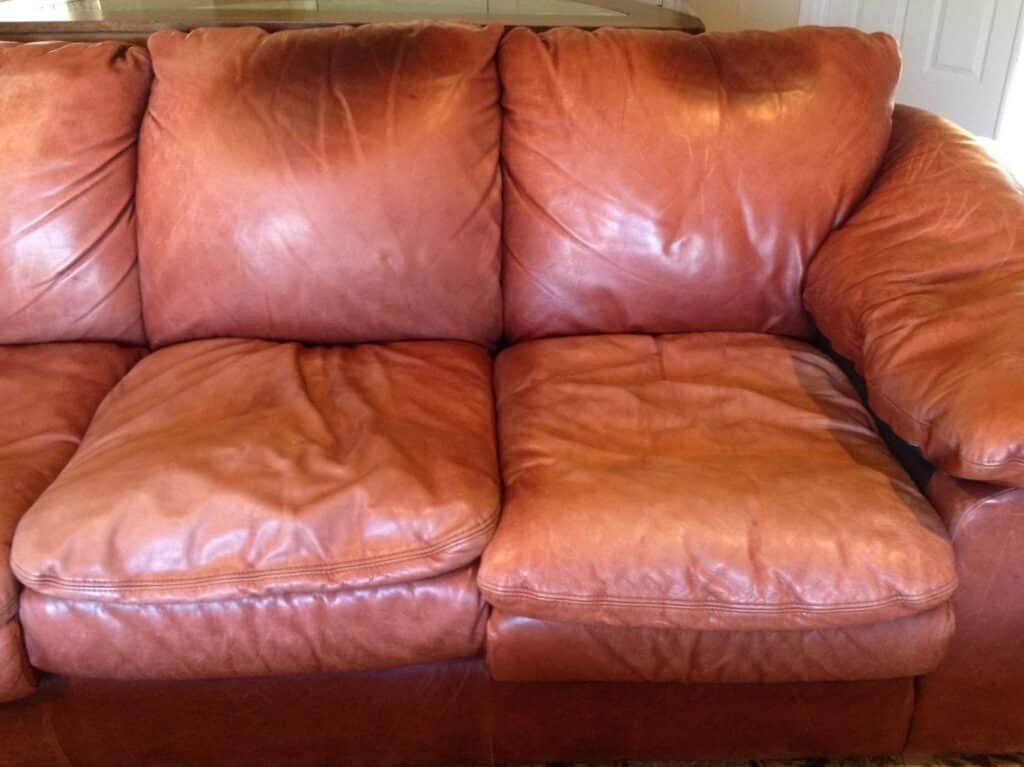
Body oils, lotions, and hair products soak into leather over time, leaving dark, often sticky patches. There are three ways to handle them, and the right approach depends on how saturated the leather is.
Cleaning and recoloring is what most of our customers do. If the leather is still in reasonable shape, you simply clean the surface with a solvent and cover the discoloration with color.
Sealing with an oil blocker is the next step up. If oil residue is keeping a new finish from bonding well, a blocker seals the surface so the color will adhere. This is a good middle path when cleaning alone isn’t enough but the leather isn’t bad enough to warrant full extraction.
Extracting the oil is the only way to actually remove oil from leather. It takes more time and materials, but it’s essential if the leather is sticky or cracking.
Cleaning and recoloring
- Clean the area with lacquer thinner.
- Apply painters’ tape to the stain. If it sticks, such that you have to pry it off with a fingernail, you’re ready to proceed. If the tape doesn’t stick well or curls along the edges, more cleaning is needed. Acetone can be used with caution. Do not use baking soda to clean leather. It is too abrasive and too alkaline. Take care not to over-scrub or chafe the leather.
- Apply Rub ‘n Restore® color over the prepped area. Match whichever color is dominant. If most of the leather is still its original color, match that and touch up the stained spots. If the oil has spread across most of the piece, it’s usually easier to change the color to match the darker stain. When restoring to a lighter color, keep in mind that the stained areas may wear faster and need occasional touch-ups, as any oil residue still in the leather may keep the new color from bonding as firmly as it should. In this case, consider applying a blocker over the stain.
Sealing with an oil blocker
If the painters’ tape test from the previous step still fails after thorough cleaning or the color doesn’t adhere well, oil residue is interfering with adhesion. An oil blocker seals what’s left at the surface so a new finish will hold.
The blocker has to be sprayed on. Wiping with a sponge or brush will remove it as you go. Once it’s dry, recolor as described above.
Extracting oil from saturated leather
If the leather is sticky, deeply saturated, or showing oil-related cracking, surface treatments alone won’t cut it. You’ll need to pull the oil out before any new finish will hold.
Use an oil extractor to draw the oil out of the leather. This is a time-consuming process (see here) and may leave the leather dry, so a moisturizer cream is often a good follow-up.
Once the leather is prepped, recolor it as described above.
What do I do if I’ve already started to recoloring the cushions & loveseat but the loveseat & seats are smearing and uneven in color. Not smooth but splotchy. Should I reclean & start over. I’m frustrated. I don’t know what to do. Looks horrible & dark.
Please use the form here. Give us your order number, as I am unable to find any records under this name or email. Include photos. Also let us know what you used to clean and how many coats you have applied.
Hi
I have a butter yellow sofa that is over 20yrs old, flexsteel, and I would like to clean and refinish. Maybe change the color to a lt tan or gray. It is absorbent and stained. Some hairline cracking is present.
Can you please talke me through the process of what products I will need? Thank you
Cheryl
Clean with alcohol. Add more foam or batting to plump up any cushions that may unzip. Apply filler to damaged areas. Work with a glaze (color diluted with clear) for at least the first coat. If you want our assessment and detailed instructions, please submit photos in the evaluation.