
Pale colors, whites, off-whites, and some bright colors like Butterscotch or, for example, a custom hot racing yellow don't cover as well as medium or dark colors. Take our discontinued Persimmon. It was mostly hot yellow with a little bright red, and it needed several coats to cover black leather where a lighter grey or tan would cover in just one to two coats.
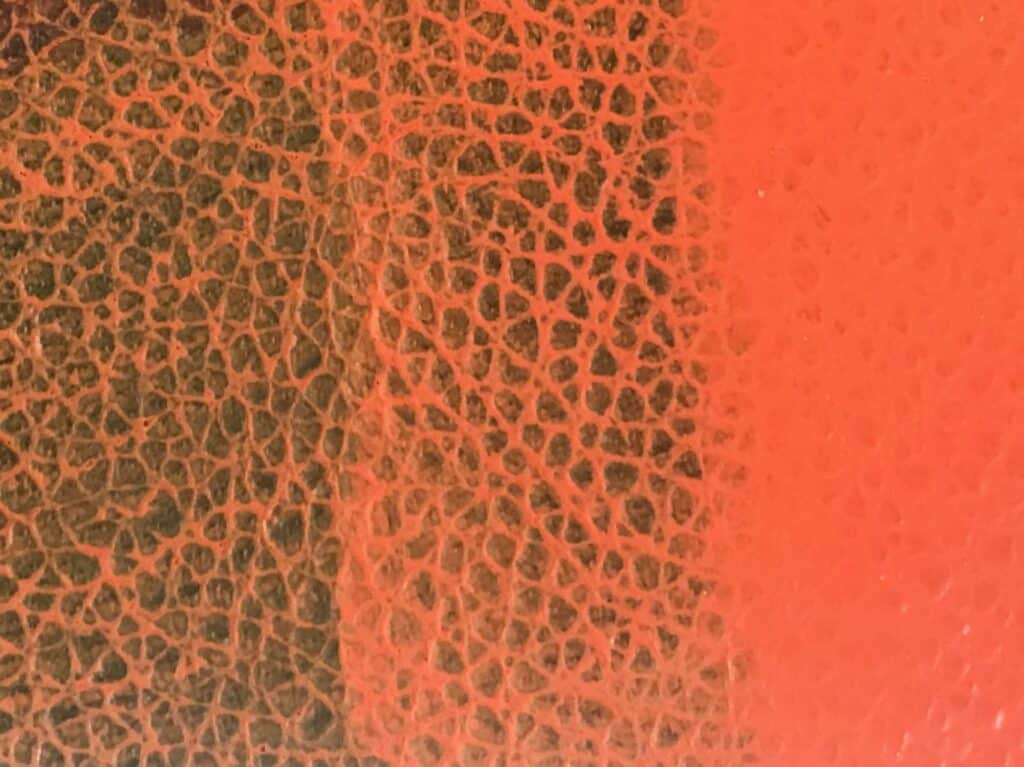
There are two different reasons a color can cover poorly, and they sit at opposite ends of pigment chemistry.
Carbon-based (organic) pigments were originally derived from plants and animals (cochineal red came from insects, Tyrian purple from sea snails), but most are now synthesized from petrochemicals. They yield brilliant, saturated hues such as phthalo blue and quinacridone red. The tradeoff is that they are transparent to semi-transparent, so they have poor hiding power, and they fade faster under prolonged sunlight or harsh chemical exposure. This is why the brightest, most saturated colors need the most coats.
Mineral (inorganic) pigments come from metals and earth elements such as iron oxide, cobalt, and titanium. They are either mined directly (ochre, sienna, lapis lazuli) or reproduced in a lab to lower costs. Their colors tend to be earthier and more muted, with some exceptions, but they are highly opaque, cover thoroughly, and stay lightfast and weather-resistant for decades.
So why does white (made from titanium dioxide, an opaque mineral pigment) struggle to hide a dark color? It's a matter of film thickness, not pigment strength. A dark color hides by soaking up light. White does the opposite: it bounces light back before it can reach the darker leather below. In a thin coat, some light slips past, hits the dark, and comes back up looking gray. The finish is simply not thick enough to bounce back all the light. The solution is to build that thickness with several thin, fully dry coats rather than one heavy one.
However, titanium dioxide is the heaviest of all the pigments. Double the number of coats to get coverage on a dark surface, and you have a heavy surface coating that, while fine for a rigid surface or seldom-used chair, is ill advised for a couch used by dogs and children. This is why we don't recommend changing from red or dark colors to white.
In such cases, a lighter earth tone (like Clay, Stone or Camel) can be used as a primer to hide the darker color and give more intensity to the new color. Choose a primer color similar in value (lightness vs. darkness) to the new color being applied.
Try dabbing or stippling the color as well, which lays it on a little more thickly than back-and-forth swiping.
Great advice ! I had similar problem with dark red Leather sofa re-colouring to bright orange.It took me 27 coats , after which I discovered I could order a more highly pigmented colourant to blitz the existing dark red tinge.This can be soul destroying if you just keep plodding on, so listen to Run N Restore’s advice to make your project run much smoother.
Hello, so after 27 coats of color, we’re you able to completely change the color?? And how long this change went, like is it still good? Not showing any cracks ??